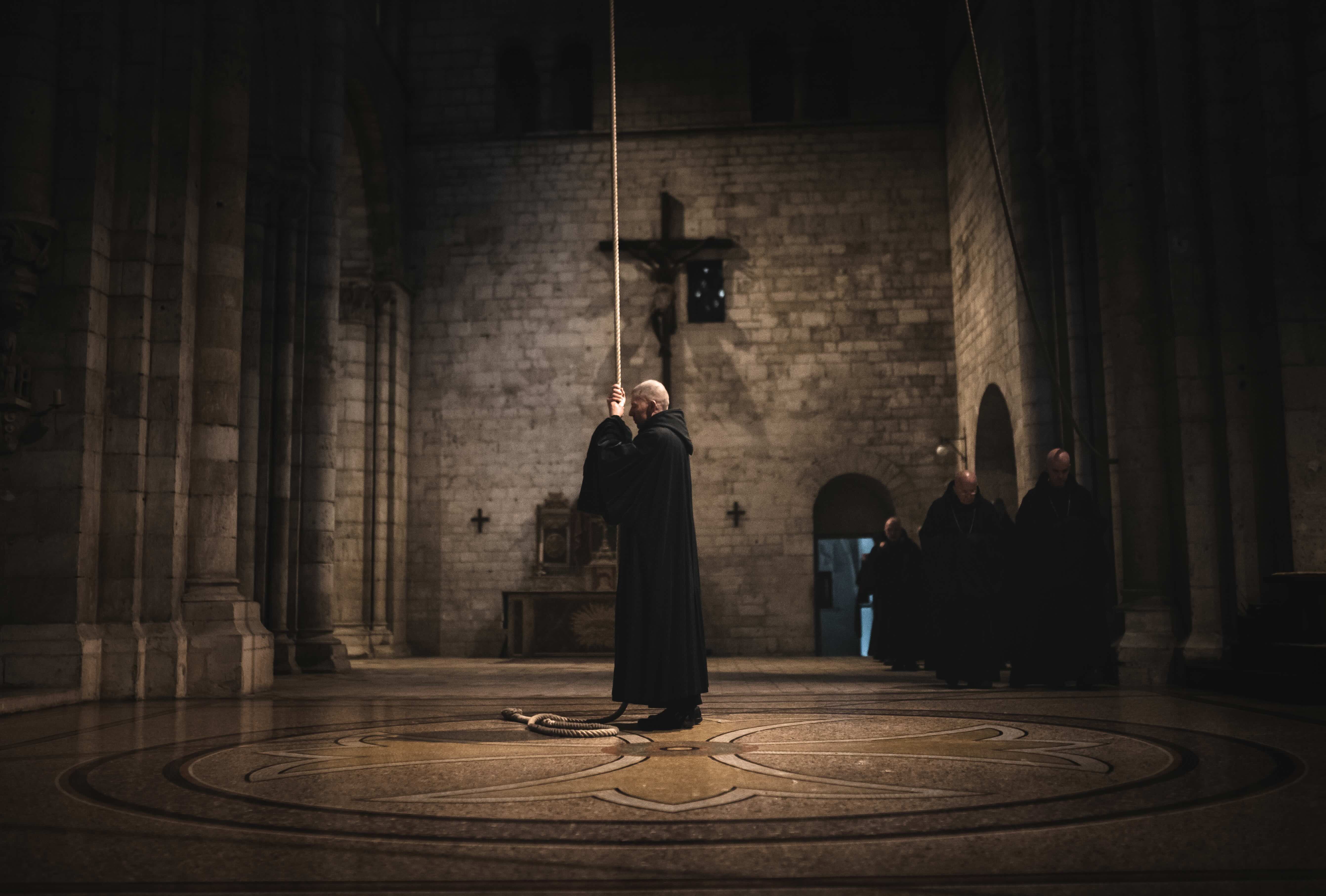
Let us get up, then, at long last, for the Scriptures rouse us when they say: “It is high time for us to arise from sleep” (Rm 13:11 (Prol 8).
In the programme of preparation for the anniversary of the founding of Monte Cassino, this first year focusses on the place Norcia (in Roman times: Nursia) where St Benedict is said to have been born, and the general theme of awakening. Some reflection on this seems a good way to begin the year.
The town of Nursia is about seventy miles north of Rome, up in the hills.
The city sits in a framework of green hills, that form but a foreground to those giant mountains which in the East and South lift their rocky sunlit peaks up into the deep blue sky.
In ancient times the area was populated by the tribe of the Sabines, some of whom were, according to famous legend, forcibly co-opted into the newly founded City of Rome. Whatever the truth of that, the men of the Sabine region were certainly considered in Rome as a byword for “toughness of fibre and rough virtue … men of a certain austerity of character and gravity of demeanour” . Virgil included warriors from “cold Nursia” in the troops of Turnus (the native Italian who fought the incursor Æneas). “It was here too that Scipio Africanus gattered together the bravest sailors for his war against Carthage.”
The Rule of St Benedict is routinely described as balanced and moderate, and this is true, but a careful reading shows that “moderate” does not imply “soft”. St Benedict takes it for granted that human nature is inclined to be compassionate towards the old and the young (RB 37.1); he expects his monks to be patient with the sick, even if the latter can be demanding (RB 36.4-5); even the wayward brothers are to be the object of special care and concern (RB 27.5). The behaviour of monks who are not weakened by their age, infirmity or instability, however, is expected to be characterised by alertness and vigour. The Rule opens with a master calling disciples, and their former state is not described as especially sinful but as having gone off course “through the sloth of disobedience” (Prol 2). As Bishop Hugh says, “For the Prologue for St Benedict, sloth – desidia – is the original sin.” If they were dozing before, they are now summoned to wake up. They are like the speakers in a well-known poem by Charlotte Mew:
We cannot sit here any more.
We must arise and go:
The world is cold without
And dark and hedged about
With mystery and enmity and doubt,
But we must go.
Thus the disciples in the Prologue are invited to continue with the process of waking up, that is, becoming conscious of what they see and hear:
Let us open our eyes to the light that comes from God, and our ears to the voice from heaven (Prol 9).
This is not an exhortation just for newcomers, because this voice from heaven calls out: “every day … If you hear his voice today, do not harden your hearts” (Prol 9-10). This verse from Psalm 94(95) will indeed sound for the Benedictine every day, since St Benedict prescribes this psalm to Vigils every day.
Once the disciple is awake, how can he stay awake? The key is a general attention – what might be called today “mindfulness”. He is told “Hour by hour keep careful watch over all you do” RB 4.48); he must “constantly remember everything God has commanded” (RB 7.11). A particular aspect of such attention is the thought of the judgment that every man should undergo: “Live in fear of judgment day … Day by day remind yourself that you are going to die” (RB 4.44,47).
The energy that the disciple puts into his obedience “not cringing or sluggish or half-hearted” (RB7.14) – will demonstrate whether he is motivated by love (RB7.10). His life should be one of sober restraint (“Refrain from too much eating or sleeping and from laziness” (RB 4, 36-38). This combination of energy and self-control is something that a Benedictine imposes on himself, not on others. His treatment of his fellows should be characterised by quiet encouragement (RB 22.8). Any spirit of competition should be channelled into trying to be the first to show respect to the others (RB 72.4).
The liturgical life of the Benedictine is a particular expression of and support for his resolve to keep awake before the Lord. He goes to the Office “leaving all” (relictis omnibus) and literally running with the utmost haste (summa cum festinatione curratur) (RB 43.1). To arrive late is a matter for shame (RB 43.7). Faults committed in the saying of the Office are to be atoned for, especially if committed through negligence (RB 45.2). Though St Benedict does not offer a complete exposition of the liturgical year, the one season he discusses in detail – Lent – is described as an opportunity to wash away the negligence of other times (RB 49.3).
The frequency of terms such as always and tireless in the Rule show that it demands sustained endeavour. We can train ourselves – or let God train us - by responding faithfully to each prompting of the Holy Spirit. In the words of Cassian:
As often as some inspiration comes into our heart, even sometimes when we are sleeping, which spurs us on to desire eternal life and salvation and which encourages us to follow God and to adhere to his commands with a salutary compunction, it is from God.
At the same time, St Benedict is aware of human frailty. Not only will the monk be tempted to take extra bodily sleep (RB 43.8) he may also be forgetful of his ideals. In this context we can recall the exhortation to make peace before sunset (RB 4.73). If we failed in virtue, we can at least be prompt to seek and to grant forgiveness.
Just as every day ends, St Benedict knows that every human life will end, and we do not know when. Hence he warns with Our Lord, Run while you have the light of life (Prol 13). As Dom Delatte comments:
Whatever may be our age, above all if we are past the prime of life and moving downwards towards the end, it is time, the appointed time, God’s hour and the hour of grace.
.png)