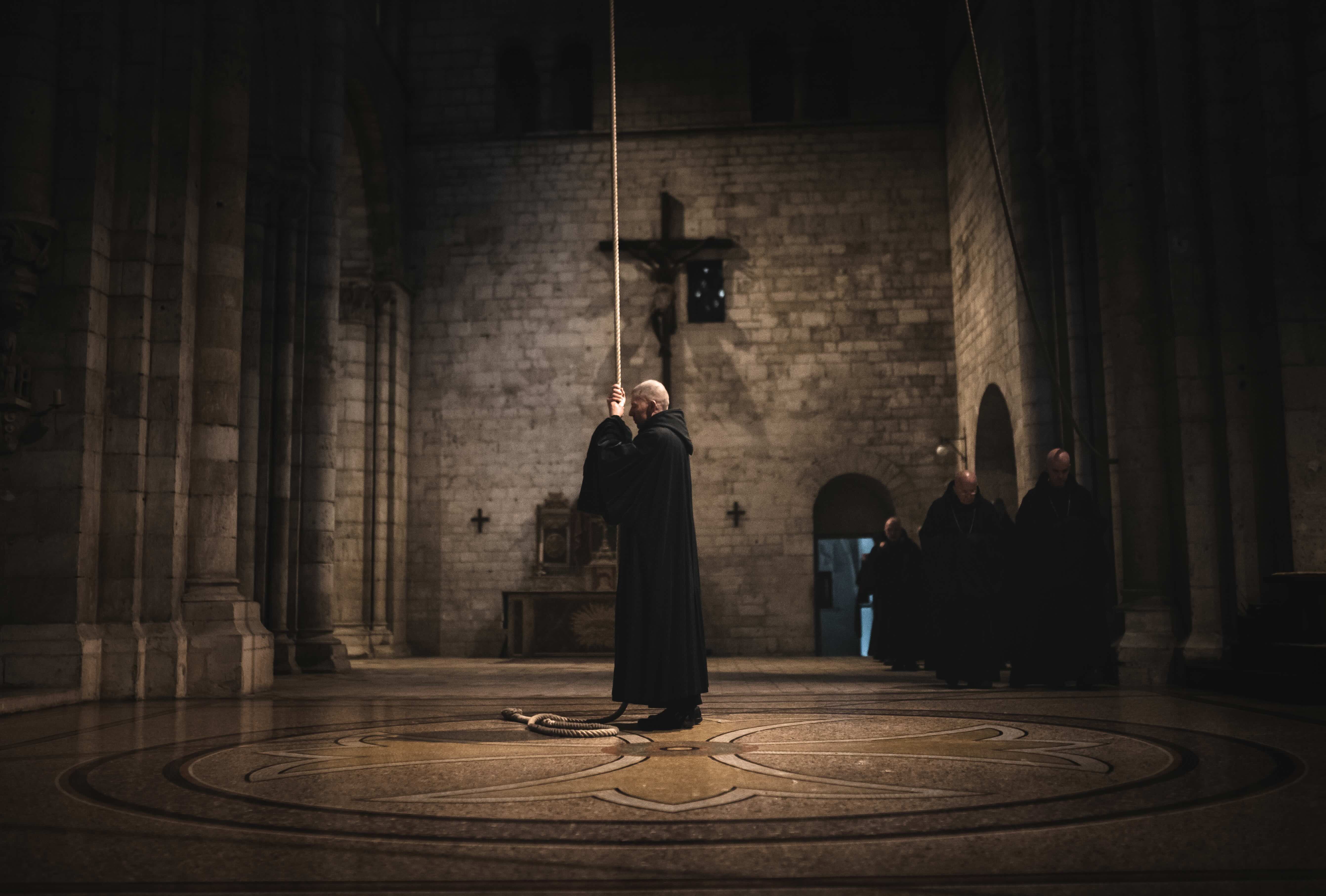
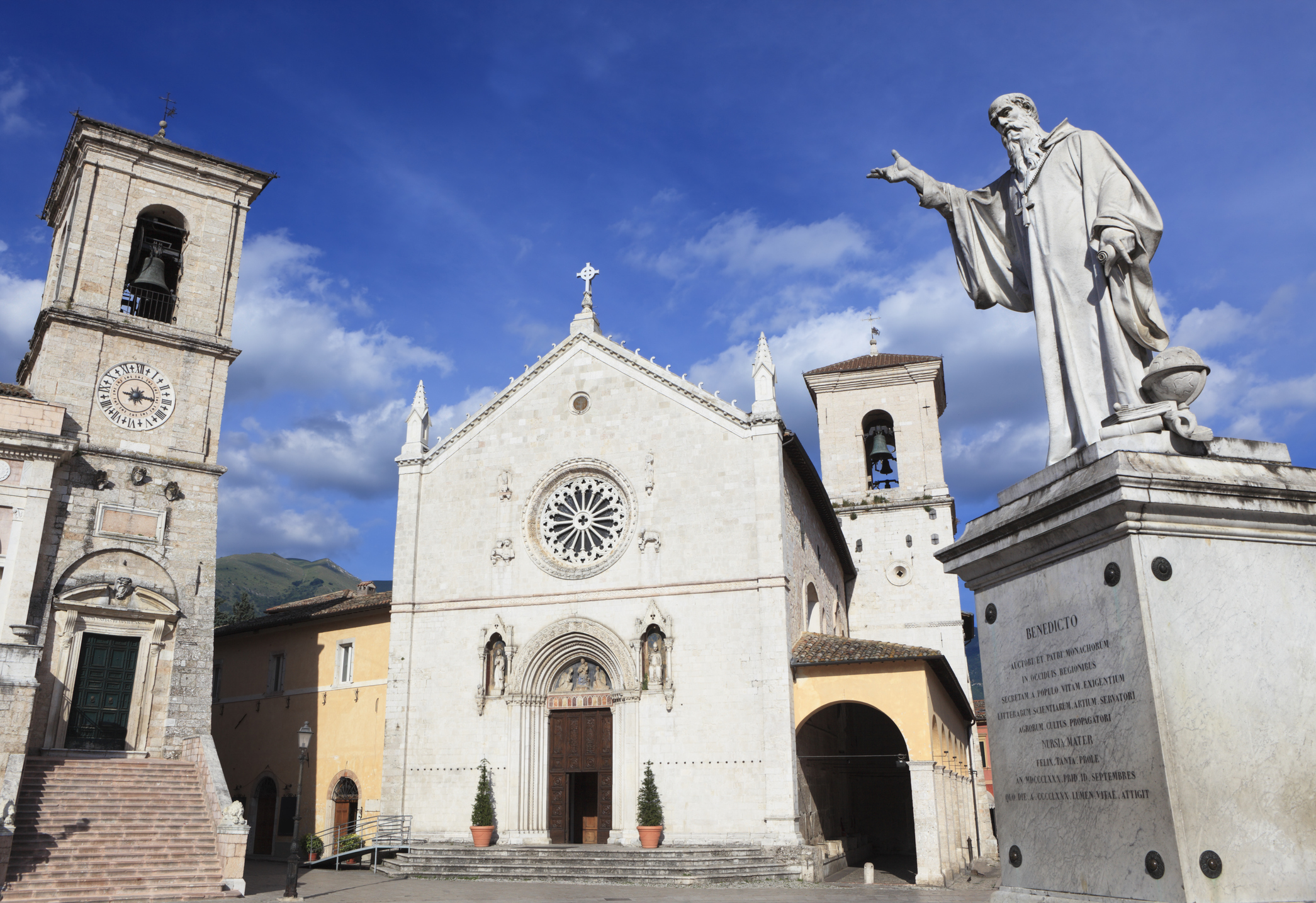
A Norcia Year seems to be an appropriate opportunity to revisit St John Henry Newman’s teaching on the Benedictine Order. The culture of Antiquity is less familiar to our generations than it was at his time. We may therefore need some adjustment to enter his view of monastic life as poetic and Virgilian. But are not poetry and proximity with God’s creation an essential contribution of monasteries at a time when our humanity is challenged by the dehumanising threats of artificial technology?
From John Henry Newman, The Mission of St Benedict (1858)
To St. Benedict, then, who may fairly be taken to represent the various families of monks before his time and those which sprang from him (for they are all pretty much of one school), to this great Saint let me assign, for his discriminating badge, the element of Poetry; to St. Dominic, the Scientific element; and to St. Ignatius, the Practical.
These characteristics, which belong respectively to the schools of the three great Teachers, grow out of the circumstances under which they respectively entered upon their work. Benedict, entrusted with his mission almost as a boy, infused into it the romance and simplicity of boyhood. Dominic, a man of forty-five, a graduate in theology, a priest and a Canon, brought with him into religion that maturity and completeness of learning which he had acquired in the schools. Ignatius, a man of the world before his conversion, transmitted as a legacy to his disciples that knowledge of mankind which cannot be learned in cloisters. And thus the three several Orders were (so to say), the births of Poetry, of Science, and Practical Sense.
Now, then, we are able to understand how it was that the monks had a unity, and in what it consisted. It was a unity, I have said, of object, of state, and of occupation. Their object was rest and peace; their state was retirement; their occupation was some work that was simple, as opposed to intellectual, viz., prayer, fasting, meditation, study, transcription, manual labour, and other unexciting, soothing employments. Such was their institution all over the world; they had eschewed the busy mart, the craft of gain, the money-changer's bench, and the merchant's cargo. They had turned their backs upon the wrangling forum, the political assembly, and the pantechnicon of trades. They had had their last dealings with architect and habit-maker, with butcher and cook; all they wanted, all they desired, was the sweet soothing presence of earth, sky, and sea, the hospitable cave, the bright running stream, the easy gifts which mother earth, "justissima tellus," yields on very little persuasion. "The monastic institute," says the biographer of St. Maurus, "demands Summa Quies, the most perfect quietness;" and where was quietness to be found, if not in reverting to the original condition of man, as far as the changed circumstances of our race admitted; in having no wants, of which the supply was not close at hand; in the "nil admirari;" in having neither hope nor fear of anything below; in daily prayer, daily bread, and daily work, one day being just like another, except that it was one step nearer than the day just gone to that great Day, which would swallow up all days, the day of everlasting rest.
I have now said enough both to explain and to vindicate the biographer of St. Maurus, when he says that the object, and life, and reward of the ancient monachism was "summa quies,"—the absence of all excitement, sensible and intellectual, and the vision of Eternity. And therefore have I called the monastic state the most poetical of religious disciplines. It was a return to that primitive age of the world, of which poets have so often sung, the simple life of Arcadia or the reign of Saturn, when fraud and violence were unknown. It was a bringing back of those real, not fabulous, scenes of innocence and miracle, when Adam delved, or Abel kept sheep, or Noe planted the vine, and Angels visited them. It was a fulfilment in the letter, of the glowing imagery of prophets, about the evangelical period. Nature for art, the wide earth and the majestic heavens for the crowded city, the subdued and docile beasts of the field for the wild passions and rivalries of social life, tranquillity for ambition and care, divine meditation for the exploits of the intellect, the Creator for the creature, such was the normal condition of the monk. He had tried the world, and found its hollowness; or he had eluded its fellowship, before it had solicited him;—and so St. Antony fled to the desert, and St. Hilarion sought the sea shore, and St. Basil ascended the mountain ravine, and St. Benedict took refuge in his cave, and St. Giles buried himself in the forest, and St. Martin chose the broad river, in order that the world might be shut out of view, and the soul might be at rest. And such a rest of intellect and of passion as this is full of the elements of the poetical.
When, then, Virgil chooses the country and rejects the town, he shows us that a certain aspect of the town is uncongenial with poetry, and that a certain aspect of the country is congenial. Repose, intellectual and moral, is that quality of country life which he selects for his praises; and effort, and bustle, and excitement is that quality of a town life which he abhors. Herein then, according to Virgil, lies the poetry of St. Benedict, in the "secura quies et nescia fallere vita," in the absence of anxiety and fretfulness, of schemes and scheming, of hopes and fears, of doubts and disappointments. Such a life,—living for the day without solicitude for the morrow, without plans or objects, even holy ones, here below; working, not (so to say) by the piece, but as hired by the hour; sowing the ground with the certainty, according to the promise, of reaping; reading or writing this present week without the consequent necessity of reading or writing during the next; dwelling among one's own people without distant ties; taking each new day as a whole in itself, an addition, not a complement, to the past; and doing works which cannot be cut short, for they are complete in every portion of them,—such a life may be called emphatically Virgilian. They, on the contrary, whose duty lies in what may be called undertakings, in science and system, in sustained efforts of the intellect or elaborate processes of action,—apologists, controversialists, disputants in the schools, professors in the chair, teachers in the pulpit, rulers in the Church,—have a noble and meritorious mission, but not so poetical a one.
When the bodily frame receives an injury, or is seized with some sudden malady, nature may be expected to set right the evil, if left to itself, but she requires time; science comes in to shorten the process, and is violent that it may be certain. This may be taken to illustrate St. Benedict's mode of counteracting the miseries of life. He found the world, physical and social, in ruins, and his mission was to restore it in the way, not of science, but of nature, not as if setting about to do it, not professing to do it by any set time or by any rare specific or by any series of strokes, but so quietly, patiently, gradually, that often, till the work was done, it was not known to be doing. It was a restoration, rather than a visitation, correction, or conversion. The new world which he helped to create was a growth rather than a structure. Silent men were observed about the country, or discovered in the forest, digging, clearing, and building; and other silent men, not seen, were sitting in the cold cloister, tiring their eyes, and keeping their attention on the stretch, while they painfully deciphered and copied and re-copied the manuscripts which they had saved. There was no one that "contended, or cried out," or drew attention to what was going on; but by degrees the woody swamp became a hermitage, a religious house, a farm, an abbey, a village, a seminary, a school of learning, and a city. Roads and bridges connected it with other abbeys and cities, which had similarly grown up; and what the haughty Alaric or fierce Attila had broken to pieces, these patient meditative men had brought together and made to live again.
.png)